7 Benefits of a Channel Manager for Small Property Owners (and How It Stops Double Bookings)
If your guesthouse is listed on Booking.com, Agoda, and Airbnb, you already have a second job. It's called updating calendars.
A guest books Room 2 on Agoda. You open Booking.com and block the same dates. Then Airbnb. Then you write it in the notebook, or the spreadsheet, or both. Then a Messenger inquiry comes in for the same weekend and you scroll back through everything to check if Room 2 is really gone.
Most small property owners do this for years before they ask the obvious question: isn't there software that does this for me?
There is. It's called a channel manager. And for a 3 to 20 room property, the benefits of a channel manager are bigger than most owners expect.
What is a channel manager?
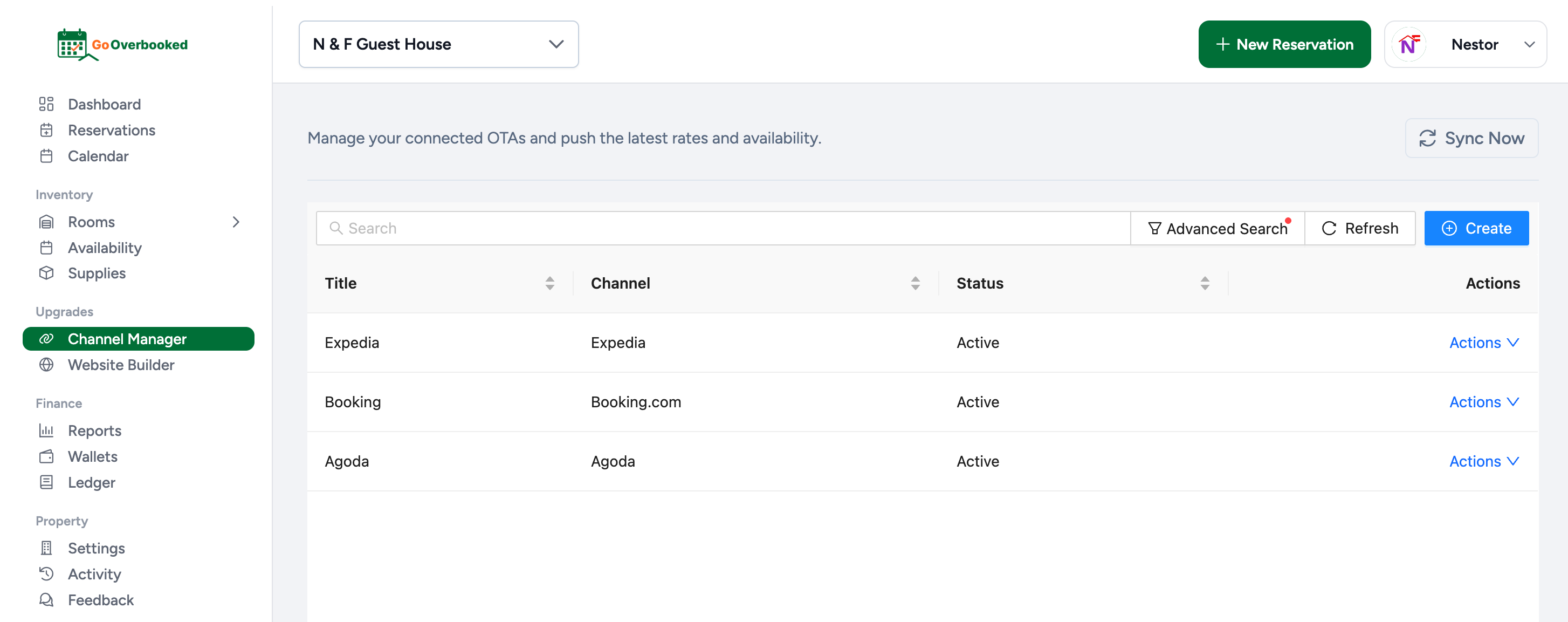
A channel manager is software that connects all your online travel agencies (OTAs) to one central calendar. When a room gets booked on one platform, the channel manager updates your availability on every other platform automatically, usually within minutes.
Think of it as the one person on your team whose only job is to watch every OTA at once and never falls asleep.
Big hotels have used channel managers for years. The difference now is that you don't need to be a big hotel to use one.
1. It prevents double bookings
This is the benefit that matters most, so let's start here.
Double bookings happen because every OTA keeps its own calendar. Booking.com doesn't know what Agoda sold ten minutes ago. If you're updating each one by hand, there is always a window where the same room is open on two platforms at once. On a slow Tuesday, that window rarely matters. On a long weekend or during peak season, it's exactly when two guests book the same room.
A channel manager closes that window. The moment Room 2 is booked on Agoda, it's blocked on Booking.com and Airbnb too. No manual step, no forgetting, no "I thought I already closed that."
And if you've ever had two guests show up at the gate for the same room, you know how much that's worth. The refund, the scramble to find them another place, the one-star review. A single prevented double booking can pay for the software many times over.
2. It saves you hours every week
Count how many times you open an OTA extranet in a week just to update availability. For most small owners with three platforms, it's dozens. Every booking, every cancellation, every date change means logging into several places and making the same change several times.
A channel manager turns that into zero. You manage your rooms in one place and the OTAs follow.
That time goes back to the things only you can do: talking to guests, fixing the aircon in Room 3, or simply taking a day off without your phone buzzing.
3. You can list on more OTAs without more stress
Many owners stay on one or two platforms, not because more exposure wouldn't help, but because every extra OTA means another calendar to babysit.
With OTA calendar sync handled for you, adding a new channel stops being a risk. You can be on Booking.com, Agoda, and Airbnb at the same time and reach guests who only search on one of them, without tripling your admin work or your chances of a double booking.
4. It helps you sell more rooms
This one surprises people. A lot of owners protect themselves from double bookings by keeping a few rooms "hidden" on some platforms, just in case. It works, but it means those rooms sit empty on nights they could have sold.
When your availability is synced in real time, you don't need that safety buffer. Every open room can be open everywhere. Over a year, those few extra nights per month add up to real money, the same kind of quiet revenue leak we wrote about in how much a missed booking is actually costing you.
5. One calendar you can actually trust
When availability lives in five places, none of them is fully true. You look at Booking.com and wonder if it's current. You check the notebook and wonder if your staff wrote down yesterday's walk-in.
A channel manager gives you a single calendar that reflects reality. That matters most when you're not the one looking at it. Your spouse, your receptionist, or a new hire can open one screen and know exactly which rooms are free, without calling you to ask.
6. Fewer human mistakes
Manual updates fail in small, boring ways. You block the wrong dates. You close Room 4 instead of Room 5. You update Agoda and get interrupted before you reach Airbnb. None of these are careless mistakes. They're what happens when a busy person does a repetitive task forty times a week.
Automation doesn't get tired or distracted. Taking the repetitive part out of your hands removes the most common source of booking errors at small properties.
7. Your business stops depending on one person's memory
In a lot of guesthouses, the real channel manager is the owner. They remember what was booked where, and the whole operation works because they're always around.
That's fine until they're sick for three days, or want a vacation, or their one staff member resigns. A channel manager, paired with a simple property management system (PMS), moves that knowledge out of one person's head and into a system anyone on the team can use.
Is a channel manager worth it for a small property?
If you list on only one OTA and take the rest of your bookings through Messenger and walk-ins, you might not need one yet. A simple booking tracker could be enough.
But once you're on two or more OTAs, the math changes quickly. Every extra platform multiplies the number of manual updates and the chances of a double booking. For most 3 to 20 room properties on multiple OTAs, a channel manager stops being a nice-to-have the first time two guests arrive for the same room.
The real question is usually cost. Many channel managers were built for hotel chains, with pricing and setup to match. That's why so many small owners look at one, see the monthly fee and the onboarding call, and go back to the spreadsheet.
Channel manager vs PMS: what's the difference?
People mix these up, so here's the short version. A channel manager syncs your availability across OTAs. A property management system (PMS) runs everything else: guest records, payments, check-ins, and bookings that don't come from OTAs at all, like Messenger inquiries and walk-ins.
For a small property, you want both in one place. Syncing your OTAs is only half the job if your Facebook bookings still live in a separate notebook.
How Go Overbooked helps
Go Overbooked was built for exactly this kind of property. It keeps your Booking.com, Agoda, and Airbnb calendars synced so a room booked on one platform is blocked everywhere else. It also puts your Messenger, walk-in, and phone bookings on the same calendar, and lets you log GCash, cash, and bank transfer payments in one place.
No training week. No enterprise contract. It's free to start, and you can try the live demo in about 30 seconds without signing up.
If you're tired of being your property's human channel manager, it's worth ten minutes to see what it feels like to let software do that job instead.
Run your hotel without the headaches.
Go Overbooked is free to start. Try the live demo in 30 seconds, no signup needed.
Try the Demo →